


AI Teacher’s Assistant: The Future of Learning in New York
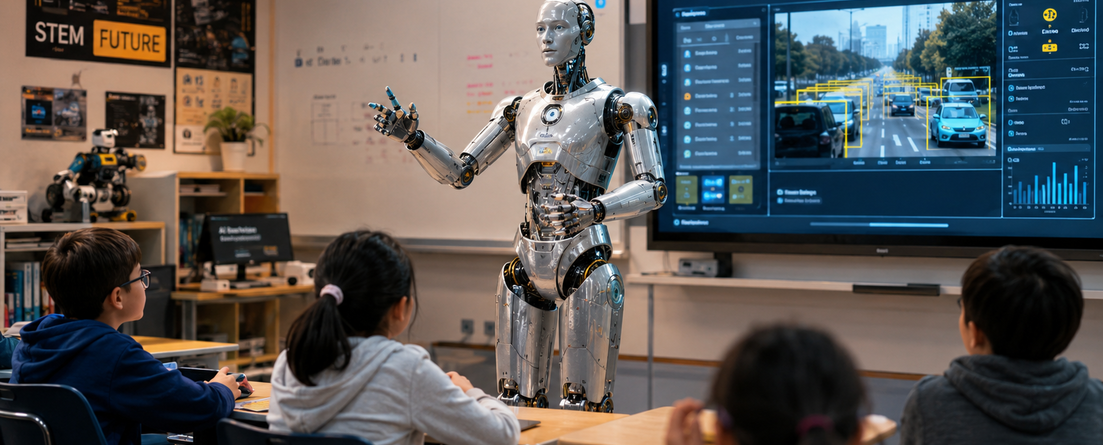
Picture this: you’re a high schooler in Salamanca, New York, and your teacher’s assistant for the day isn’t a college student or a substitute. It’s a humanoid robot that can look you in the eye, answer your questions, and remember exactly where you left off in the curriculum. That’s no longer science fiction — it’s happening right now.
Realbotix, a U.S.-based developer of humanoid robots and AI systems, has officially launched what it’s calling a first-of-its-kind deployment of both a humanoid robot and an AI teacher’s assistant in an American school district. The company’s Optio platform and its M-Series humanoid robot are now part of the learning environment at Salamanca City Central School District, located on the Seneca Nation Reservation in upstate New York.
More Than Just a Gimmick
It’s easy to roll your eyes at tech companies pitching their products to schools. Plenty of flashy pilot programs have come and gone over the years, leaving little behind but press releases. But this one is worth paying attention to — and the details are where things get interesting.
Optio isn’t a chatbot slapped onto a school portal. It’s an AI-powered assistant that lets students interact with personalized digital avatars trained directly on the district’s approved curriculum. Homework help at 11 p.m.? Covered. Need the same concept explained five different ways in Spanish? Also covered. The platform is designed to provide one-on-one tutoring, multilingual support, and around-the-clock academic access — all while staying within guardrails set by the district itself.
Then there’s the M-Series robot. This isn’t a screen on wheels. It uses natural language processing, expressive facial movements, and real-time conversational ability to engage students in what the company describes as a genuinely human-like interaction. It can answer questions, participate in discussions, and deliver educational content through spoken dialogue — letting students engage with embodied AI face to face rather than through a keyboard.
The School That Said Yes
The fact that this is happening in Salamanca isn’t random. The district is a recognized Woz ED STEM Pathway school — a network founded by Apple co-founder Steve Wozniak to give students real pathways into careers in technology and emerging fields. High schoolers in Woz ED AI and Robotics courses will be the first to work directly with both Optio and the M-Series robot.
The plan is to expand from the initial pilot to roughly 500 high school students by the fall of 2026, with the district collecting feedback from both educators and students to shape how the platform develops over time.
Salamanca’s superintendent, Dr. Mark Beehler, has been candid about the challenges schools are already facing with AI. Students are using it whether schools like it or not, and a lot of what’s out there is poorly suited for a classroom — biased, inaccurate, or just plain inappropriate. His take on the Realbotix partnership is that it finally gives the school a version of AI they can actually stand behind: one trained on their own curriculum, protected by strong content and privacy safeguards, and designed to complement teachers rather than compete with them.
What This Is — And What It Isn’t
Here’s the thing that often gets lost in coverage of education technology: the question of replacement. Is this the beginning of robots taking over classrooms?
Not according to anyone involved. Realbotix has been clear that the system is built to keep teachers in full control of content delivery. Optio is designed to handle the repetitive, time-consuming work — concept reinforcement, after-hours tutoring, differentiated support for students who learn differently — so that human teachers can focus on the parts of teaching that actually require a human.
There’s also a meaningful inclusion angle here. The platform is specifically designed to support neurodiverse learners, offering personalized pathways and always-available reinforcement for students who might struggle in a standard classroom setting. For a district that serves students on a Native American reservation — a community that has historically been underserved by mainstream education technology — equitable access to high-quality learning tools is no small thing.
A Bigger Picture
For Realbotix, Salamanca is just the starting point. The company is framing this as its flagship deployment and a template for a broader rollout strategy — measuring student engagement, concept mastery, and teacher workload reduction before scaling to additional districts and STEM-focused schools.
CEO Andrew Kiguel put it plainly: the goal is to move beyond lab demonstrations and prove that humanoid robots can function in live educational environments. If the Salamanca experiment holds up, the company will have something rare in the edtech world — an actual proof of concept with real kids, real teachers, and real data.
Whether or not you think a robot belongs in a classroom, one thing is hard to argue with: the technology is no longer waiting for permission. It’s already in the room.

LEAVE A COMMENT