


The Future of Robotics: How Gemini ER 1.5 Thinks and Acts
Modern robots have become incredibly capable at moving, grasping, and navigating. Yet physical movement alone isn’t enough. To operate in homes, warehouses, hospitals, and factories, robots must understand their surroundings, reason about complex situations, create plans, and adapt when conditions change.
This is exactly what Gemini Robotics-ER 1.5 from Google DeepMind was designed to solve.
Rather than directly controlling motors, Gemini Robotics-ER 1.5 acts as a robot’s high-level reasoning engine. It observes the environment, understands human instructions, plans multi-step tasks, estimates progress, and determines the best actions before passing execution to a Vision-Language-Action (VLA) model.
The result is a new generation of robots that don’t simply follow commands—they can think through problems before acting.
What Is Gemini Robotics-ER 1.5?
Gemini Robotics-ER 1.5 is an Embodied Reasoning (ER) model built specifically for robotics.
Unlike traditional AI assistants that operate only in digital environments, this model understands the physical world by combining:
- Computer vision
- Spatial reasoning
- Natural language understanding
- Task planning
- Progress estimation
- Tool use
- Multi-step reasoning
Its purpose is to serve as the “brain” behind robots, allowing them to analyze their environment and determine how a task should be completed before any physical movement begins.
How It Works
The Gemini Robotics platform uses two complementary AI models.
Gemini Robotics-ER 1.5 (Reasoning)
Responsible for:
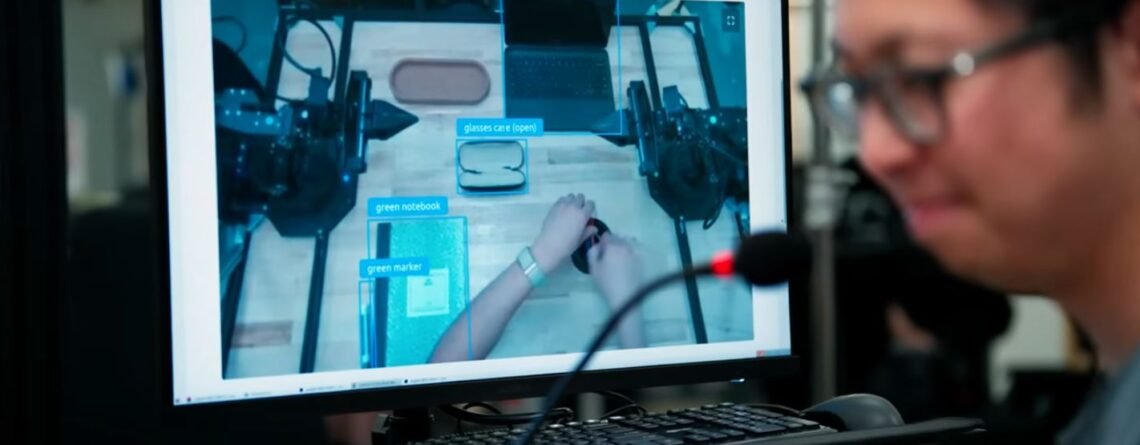
- Understanding scenes
- Identifying objects
- Reasoning about space
- Creating plans
- Monitoring task completion
- Calling external tools
Gemini Robotics 1.5 (Action)
Responsible for:
- Executing physical movements
- Controlling robotic arms
- Manipulating objects
- Performing motor actions
Think of it like a human:
- Gemini Robotics-ER is the brain.
- Gemini Robotics is the body.
Together they allow robots to perceive, reason, and act far more intelligently than previous robotic systems.
Key Features
1. Advanced Visual Understanding
The model can recognize:
- Objects
- Containers
- Furniture
- Tools
- Human actions
- Relative positions
It doesn’t simply detect objects—it understands how they relate to one another inside a three-dimensional environment.
For example:
Instead of seeing:
Apple. Bowl. Table.
It understands:
“The apple is inside the bowl on the left side of the table.”
This spatial awareness is essential for intelligent robotic manipulation.
2. Spatial Reasoning
Robots constantly face spatial challenges:
- Which object blocks another?
- Can an item fit into a container?
- Which path avoids collisions?
- Which object should be picked first?
Gemini Robotics-ER performs this reasoning naturally, helping robots solve tasks that require understanding of geometry and object relationships rather than relying on fixed programming.
3. Multi-Step Task Planning
Real-world work rarely consists of a single action.
For example:
“Pack everything I need for tomorrow.”
The robot may determine it should:
- Check the weather.
- Find appropriate clothing.
- Pack electronics.
- Add a charger.
- Include an umbrella if rain is expected.
- Verify nothing is missing.
Instead of requiring instructions after every step, the model builds a complete plan and continuously updates it as work progresses.
4. Progress Estimation
One of the biggest challenges in robotics is knowing whether a task is actually complete.
Gemini Robotics-ER continuously evaluates:
- What has already been completed
- What remains unfinished
- Whether an error occurred
- Whether replanning is required
This makes robots significantly more autonomous during long, complex missions.
5. Native Tool Use
Unlike earlier robotic AI systems, Gemini Robotics-ER can directly use external digital tools.
These include:
- Google Search
- APIs
- Databases
- User-defined software functions
- External reasoning modules
For example, a robot asked to recycle trash could first search for local recycling rules before deciding where each item belongs.
6. Natural Language Interaction
Users don’t need technical commands.
Instead of programming a robot, people can simply say:
- “Clean the kitchen.”
- “Pack my backpack.”
- “Find my glasses.”
- “Organize this table.”
The model interprets everyday language, creates an execution plan, and coordinates with the action model to complete the task.
Why Embodied Reasoning Matters
Large Language Models transformed computers.
Embodied reasoning aims to do the same for robots.
Traditional robots relied on:
- Fixed scripts
- Hard-coded rules
- Repetitive tasks
- Structured environments
Gemini Robotics-ER enables robots to operate in changing environments by understanding context rather than following rigid instructions.
This represents one of the largest shifts in robotics since the introduction of modern AI.
Potential Applications
Manufacturing
Robots can:
- Assemble products
- Organize workstations
- Detect missing parts
- Adapt to production changes
Warehousing
They can:
- Pick products
- Sort inventory
- Load containers
- Optimize workflows
Healthcare
Future applications include:
- Delivering supplies
- Organizing medical equipment
- Assisting caregivers
- Supporting rehabilitation
Home Robotics
Household robots may eventually:
- Prepare meals
- Clean rooms
- Organize groceries
- Fold laundry
- Assist elderly individuals
- Retrieve misplaced objects
Because Gemini Robotics-ER reasons before acting, these tasks become far more reliable in dynamic home environments.
Available Through the Gemini API
Google has made Gemini Robotics-ER 1.5 available in preview for developers through Google AI Studio and the Gemini API, enabling robotics teams to build and test embodied reasoning into their own systems. The execution-focused Gemini Robotics 1.5 VLA model is available to select partners.
Looking Ahead
The future of robotics will not be defined solely by stronger motors or better hardware.
It will be defined by intelligence.
Gemini Robotics-ER 1.5 demonstrates how robots can combine perception, reasoning, planning, and digital tool use to solve problems that once required constant human supervision. As embodied AI continues to evolve, robots are becoming more adaptable, more collaborative, and better equipped to operate in the real world.
For researchers, developers, and businesses, this marks an important step toward truly general-purpose robotic assistants capable of understanding both human language and the physical environments around them.
Final Thoughts
Gemini Robotics-ER 1.5 represents a significant milestone in embodied AI. By giving robots the ability to interpret complex scenes, reason spatially, plan long-horizon tasks, estimate progress, and access external knowledge, Google DeepMind is moving robotics beyond automation and toward genuine physical intelligence.
While widespread deployment will require continued advances in hardware, safety, and real-world validation, the technology provides a compelling glimpse into the future—one where robots are not only capable of acting, but of understanding why and how they should act.

LEAVE A COMMENT