


Why Is the Human Hand Difficult to Imitate?
Walk into any robotics lab today and you’ll find machines that can weld car frames with millimeter precision, lift loads no human could budge, and perform repetitive tasks for years without tiring. Yet ask that same lab to build a robotic hand that can casually pick up an egg, flip a pancake, or button a shirt, and things get a lot harder, a lot faster.
This isn’t a lack of trying. Robotic hands have been a holy grail of engineering for over 50 years. And still, nothing built in a lab comes close to matching what’s attached to the end of your own arm. Here’s why, from a robotics point of view, the human hand remains one of the toughest things in the world to replicate.
The Actuation Problem: Too Many Moving Parts, Too Little Space
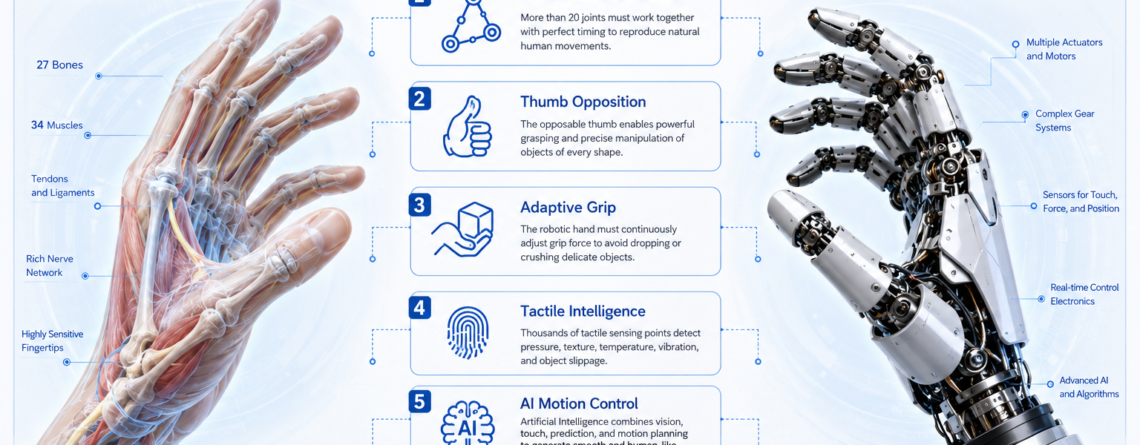
A human hand has 27 bones and around 20+ degrees of freedom, powered by more than 30 muscles — most of which don’t even sit in the hand itself, but in the forearm, pulling on long tendons like a puppeteer working strings from a distance.
For a robot, every one of those movements needs a motor, a set of gears, wiring, and control electronics. Cramming that much actuation hardware into a space the size of a human palm is a serious engineering bottleneck. Most robotic hands compromise by using fewer independent joints, tendon-driven systems that link multiple fingers together, or underactuated designs where one motor controls several joints at once. These solutions work, but they sacrifice the fine independent control that makes human fingers so versatile.
Rigid Robots vs. a Soft, Forgiving Hand
Most robots are built from rigid materials — metal, hard plastic, carbon fiber — because rigidity is easy to model and control mathematically. But human hands are soft. Skin stretches, fat pads compress, and tendons have a small amount of give.
That softness isn’t incidental; it’s what allows your hand to instinctively conform to the shape of whatever it’s holding, whether it’s a coffee mug, a doorknob, or an irregular rock. A rigid robotic gripper has no such luxury. It has to calculate the exact geometry of an object and plan an exact grip, and if that calculation is even slightly off, the grip fails.
This is why “soft robotics” has become such an active research field. Engineers are experimenting with silicone fingers, pneumatic actuators, and flexible materials that mimic biological compliance. Progress has been impressive, but soft robotic hands are still far behind biological ones in durability, speed, and precision.
Sensing: The Missing Sense in Most Robots
Here’s a detail people rarely consider: your hand is covered in sensors. Thousands of receptors in human skin detect pressure, texture, vibration, and temperature, feeding a constant stream of data to the brain. That’s what lets you tighten your grip on a heavy box and loosen it on a paper cup, almost without thinking.
Most robotic hands, by comparison, are functionally “numb.” Some advanced designs incorporate tactile sensors on fingertips, but achieving anything close to human-level sensory resolution — while keeping the hand small, durable, and affordable — is an unsolved engineering challenge. Without rich tactile feedback, a robot has to rely almost entirely on cameras and pre-programmed force limits, which is a poor substitute for touch.
The Control Problem: Software Is Harder Than Hardware
Even if you built a perfect mechanical replica of a human hand, you’d still need something to control it — and this might be the hardest part of all.
A disproportionately large part of the human brain’s motor cortex is devoted to hand and finger movement. Every grasp involves rapid, largely unconscious calculations that combine visual input, memory of past experience, and live sensory feedback, adjusted dozens of times per second.
For robots, this kind of dexterous manipulation is one of the most difficult problems in AI and control theory. Researchers use techniques like reinforcement learning, where robotic hands attempt a task millions of times in simulation before transferring the learned behavior to physical hardware. Even with today’s best machine learning methods, tasks a toddler performs instinctively — like stacking uneven blocks or turning a key — remain genuinely difficult for robots to master reliably across different objects and conditions.
Strength Was Never the Issue — Dexterity Is
It’s worth clarifying something: robots surpassed human strength a long time ago. Industrial arms can lift tons; robotic grippers can crush steel. The real unsolved problem is dexterity — small, precise, adaptable movements performed with the right amount of force, adjusted instantly if something goes wrong.
Dexterity requires combining strength, sensitivity, and real-time adaptability all at once. A robotic hand might manage one or two of those well, but combining all three in a single compact, reliable system is where current robotics still falls short.
Why Roboticists Keep Trying Anyway
Despite the difficulty, building better robotic hands remains a major priority, because the payoff is enormous:
- Prosthetics: A robotic hand that can approximate natural grip and sensory feedback could transform life for amputees.
- Manufacturing and logistics: Many jobs still require human workers specifically because robots can’t yet handle delicate, irregular, or unpredictable objects.
- Surgical robotics: Precision surgery benefits directly from advances in dexterous robotic manipulation.
- Search and rescue, space exploration: Robots that can manipulate objects as skillfully as humans could operate in environments too dangerous for us.
Companies and research labs — from university robotics departments to major tech companies working on humanoid robots — are pouring significant resources into solving this exact problem, because whoever builds a hand that truly rivals the human one will unlock a huge range of new applications.
The Bottom Line
From a robotics standpoint, the human hand isn’t hard to imitate because of any single feature. It’s the combination — dense actuation packed into a tiny space, natural compliance, rich tactile sensing, and a control system capable of adjusting in real time — that makes it so extraordinarily difficult to reproduce.
We’ve made real progress: soft robotic fingers, tactile sensors, and AI-driven grasping algorithms are all steadily closing the gap. But for now, the elegant machine at the end of your arm remains, in many ways, ahead of anything engineers have managed to build.

LEAVE A COMMENT