


Humanoids Just Had Their Biggest Week Ever: NVIDIA’s SOMA, a Robot Takeover in Lisbon, and JPMorgan’s 400,000-Robot Forecast
Three stories landed in the same week, and together they tell you exactly where humanoid robots stand right now: the tools to teach them are going open source, they’re headlining the world’s biggest tech conference, and Wall Street just put a number on the whole thing. Here’s what happened — and what it actually means.
1. NVIDIA’s SOMA Retargeter: Teaching Robots to Move Like Us
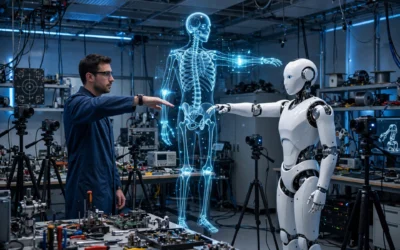
On November 13, NVIDIA released SOMA Retargeter v0.2, a free, open-source tool that turns recorded human movement into joint commands a humanoid robot can actually play back.
The idea is simple, and the engineering is not. Human motion-capture data — stored as BVH animation files on NVIDIA’s shared SOMA skeleton — gets scaled to fit a specific robot’s proportions, run through an inverse-kinematics solver built on NVIDIA Warp and Newton, and corrected in post-processing. The output is a CSV file with the robot’s root position, orientation, and every joint angle, frame by frame.
Version 0.2 ships with ready-made configurations and reference results for five humanoid robots: the Unitree G1 and H2, the Booster T1, and the AgiBot X2 Ultra and A3T3. The motion data comes from the BONES-SEED motion-capture dataset, while a companion tool, GEM-X, can rebuild full 3D human motion from ordinary video. ROBOTIS is already using the retargeter to build motion for its AI Sapiens humanoid.
One honest caveat, straight from NVIDIA: what comes out is joint poses, not a finished controller. The tool is still in beta, and the company says to validate every motion in simulation before a real robot tries it. Still, this is the kind of infrastructure that quietly accelerates an entire field — instead of every lab solving the same motion problem from scratch, they now start from the same skeleton.
2. Web Summit 2026: The Robots Took the Stage — Literally
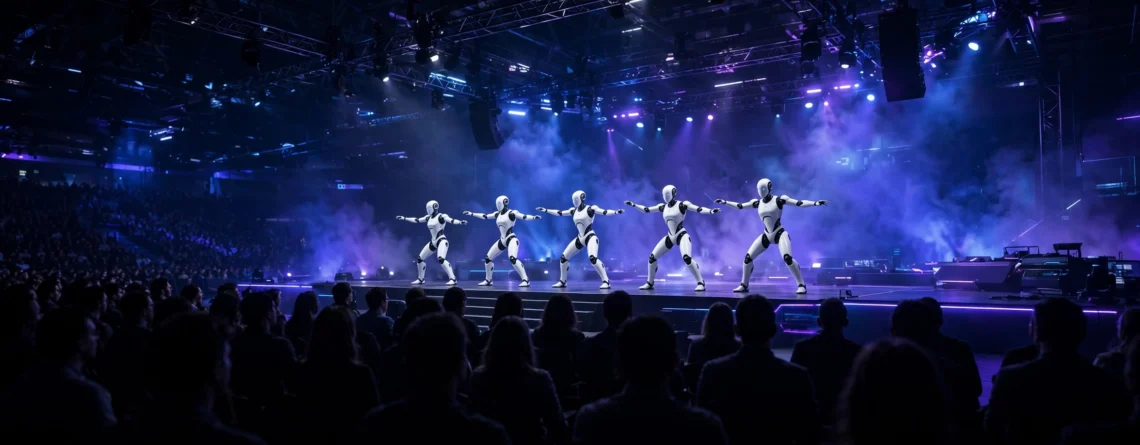
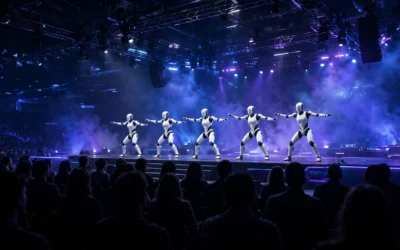
Web Summit opened in Lisbon on November 9 for its tenth edition in Portugal, with around 70,000 participants from 164 countries. And the opening image wasn’t a keynote slide or a founder’s pitch. It was nine humanoid robots from China’s AgiBot performing a synchronized dance on the MEO Arena stage, in front of up to 12,000 people — before any human speaker had walked on.
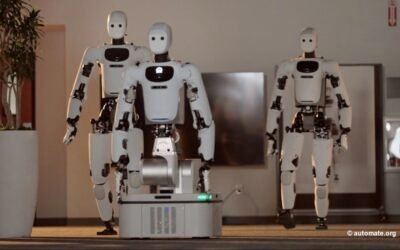
It didn’t stop at a dance. For the first time in the event’s history, humanoid robots were listed as official speakers, on the same programme as company founders and policy officials. Among them: AgiBot’s A3, Galbot’s G1 — a wheeled, dual-armed robot built for real shifts in shops, pharmacies, and factories — and PrimeBOT’s Q1, alongside units from UBTech and others. Web Summit called it the largest robot lineup the conference has ever staged.
China sent its largest delegation ever to a Western technology conference: more than 50 figures from its AI and robotics sectors, plus official delegations from the Ministry of Commerce and the Cyberspace Administration. Web Summit founder Paddy Cosgrave put it bluntly before the crowd: “The superstars of the future don’t come from California, they come from China.”
The theme running through it all was physical AI — artificial intelligence designed to act in the real world, not just to write text. (Storm Charles did briefly steal the show itself, forcing the cancellation of the November 11 programme before the event resumed on November 12.)
A staged dance is not proof that a robot can hold down a job, and it’s worth saying so plainly. But a robot listed as a speaker, in front of 70,000 people, is a signal about where the industry’s center of gravity is moving — and right now, it’s moving fast, and a lot of it is coming from China.
3. JPMorgan: 400,000 Humanoids a Year by 2030
On November 12, JPMorgan published a research note that put hard numbers on the humanoid business: U.S. humanoid robot production could reach 300,000 to 400,000 units a year by 2030, climbing to roughly 1.5 million by 2035.
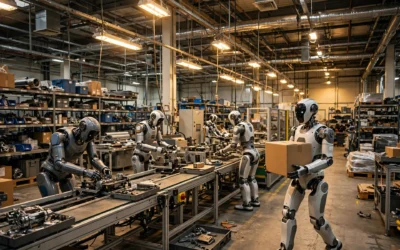
What’s driving it, according to the bank: labour shortages, costs that are approaching parity with human wages, and rising production capacity. A humanoid running multiple shifts could save a customer around $100,000 a year, JPMorgan estimates — which is why the first buyers will be industrial companies, logistics operators, and warehouses, not living rooms.
But the more useful part of the report is what it says is holding the industry back. It’s not demand. It’s supply: dexterous hands, actuators, compute and training data, and production capacity. Excluding Tesla, most American humanoid makers are currently targeting just 10,000 to 30,000 units a year — a long way from 400,000.
That’s why JPMorgan thinks the money flows to parts first. The market for the components inside these machines — actuators, motors, and vision systems — could approach $30 billion by 2035, with suppliers like Timken, Robotis, Orbbec, and Cognex named as beneficiaries. Among the robot makers themselves, the bank highlights Tesla’s Optimus, Agility Robotics’ Digit, Boston Dynamics’ Atlas, Figure AI’s robots, and Apptronik’s Apollo. The same week, GXO Logistics signed a letter of intent for up to 1,000 Apptronik Apollo robots over four years.
There’s also a policy variable: the Trump administration has identified imported robots and industrial machinery as a national security risk, which could mean tariffs or other measures designed to push production onshore.
What This Week Actually Means
Put the three stories together and the picture is clear. The software to teach humanoids is getting cheaper and more open. The stage — the biggest one in tech — now belongs to them. And the money is starting to follow, with real numbers and real contracts attached.
The gap between the forecast and the factory floor is still wide. Hands, actuators, and production lines are the real race now, not headlines. But this was the week humanoids stopped being a demo and started being a plan.
Sources: NVIDIA Developer Blog — Adapt Human Motion for Robots with NVIDIA SOMA Retargeter · Euronews via Portugal.fr — Humanoid robots take centre stage at Web Summit 2026 · The Robotics Media — JPMorgan: US Humanoid Robot Output Could Hit 400,000 by 2030

LEAVE A COMMENT