


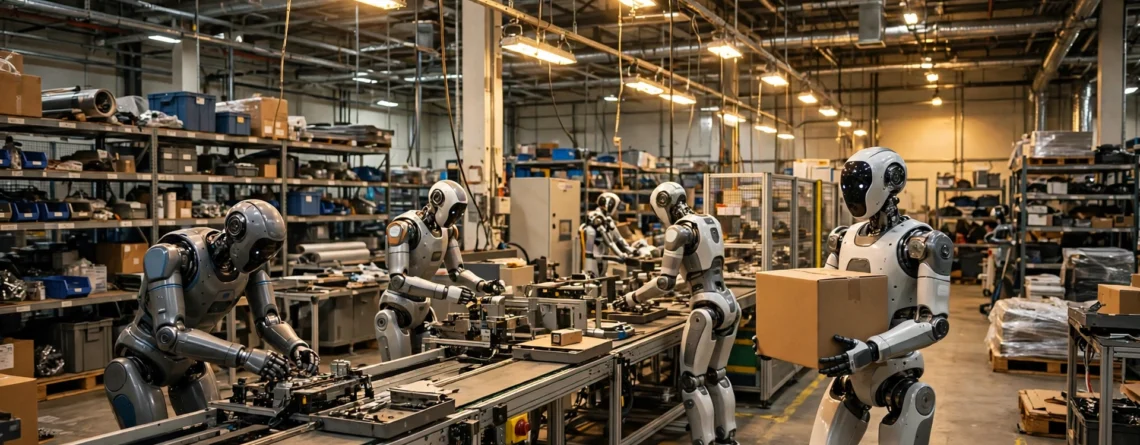
JPMorgan: 400,000 Humanoid Robots a Year in the U.S. by 2030
On November 12, JPMorgan published a research note that put hard numbers on the humanoid business: U.S. humanoid robot production could reach 300,000 to 400,000 units a year by 2030, climbing to roughly 1.5 million by 2035.
What’s Driving It
According to the bank, three forces are pushing adoption: labour shortages, costs that are approaching parity with human wages, and rising production capacity. A humanoid running multiple shifts could save a customer around $100,000 a year, JPMorgan estimates. That’s why the first buyers will be industrial companies, logistics operators, and warehouses — businesses looking to automate repetitive tasks — not living rooms.
The industry, in JPMorgan’s view, is shifting from the demonstration phase to commercial deployment. The same week the report landed, GXO Logistics signed a letter of intent for up to 1,000 Apptronik Apollo robots over four years — a concrete, named commitment with KPI-gated, multi-year timelines, not demo-day hype.
The Bottleneck Is Supply, Not Demand
But the more useful part of the report is what it says is holding the industry back. It’s not customer appetite. It’s a narrow set of hardware constraints: dexterous hands, actuators, the robot’s brain — compute and training data — and production capacity. “Near-term progress remains supply constrained,” the analysts wrote.
The gap is stark. Excluding Tesla, most American humanoid manufacturers are currently targeting just 10,000 to 30,000 units a year — a long way from 400,000. Stated production plans, JPMorgan notes, do not equate to actual output.
The Money Flows to Parts First
That’s why the bank thinks component suppliers capture the value first. The market for the parts inside these machines — actuators, motors, and vision systems — could approach $30 billion by 2035. Suppliers named as beneficiaries include Timken, Korea’s Robotis, China’s Leader Harmonious Drive Systems, Orbbec, and Cognex.
Among the robot makers themselves, JPMorgan highlights five U.S. players: Tesla’s Optimus, Agility Robotics’ Digit — already working in Amazon warehouses — Boston Dynamics’ Atlas, Figure AI’s robots, and Apptronik’s Apollo.
The Policy Variable
There’s also a political angle. JPMorgan notes the Trump administration has identified imported robots and industrial machinery as a national security risk, which could lead to tariffs or other measures designed to move production onshore. For a forecast built on U.S. production numbers, that policy tailwind matters — and so does the risk that it changes.
The Gap Between the Forecast and the Order Book
For now, the industry is firmly in its first phase, which is why the forecast and the order book look so far apart. The numbers are easy to wave off as speculative — until the same week produces real contracts like the GXO-Apptronik deal. None of these timelines are fast: trials in 2027, market availability in 2028, KPI gates at every step. That caution is exactly why it’s believable. The race now is hands, actuators, and production lines — not headlines.
Sources: The Robotics Media — JPMorgan: US Humanoid Robot Output Could Hit 400,000 by 2030

LEAVE A COMMENT