


NVIDIA’s SOMA Retargeter Turns Human Motion Into Robot Movement — and It’s Open Source
Teaching a humanoid robot to move like a person has always been one of the hardest problems in robotics. On November 13, NVIDIA handed developers a powerful shortcut — and made it free.
What SOMA Retargeter Does
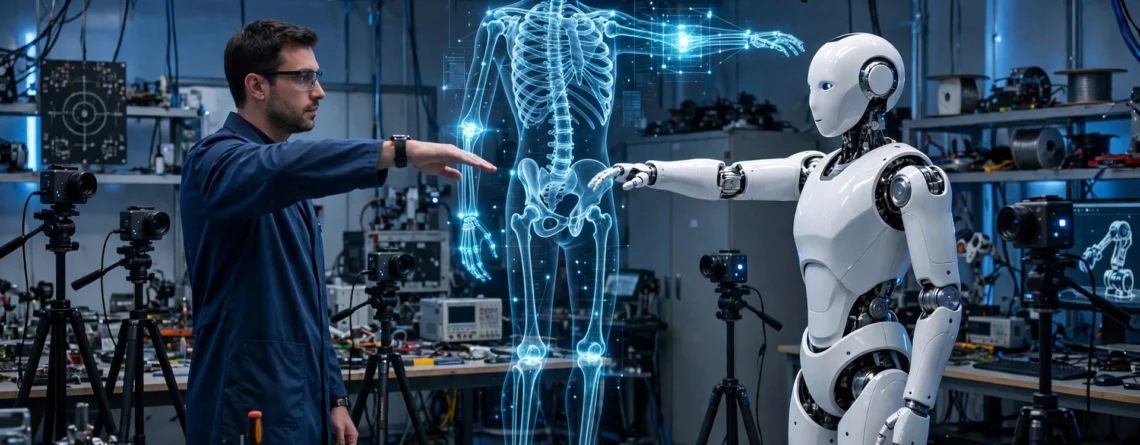
SOMA Retargeter v0.2 is an open-source tool that converts recorded human movement into joint trajectories a humanoid robot can play back. The pipeline works like this: it reads a human motion file — a Biovision Hierarchy (BVH) animation built on NVIDIA’s shared SOMA skeleton — scales the motion targets to match the robot’s proportions, solves for the joint poses with an inverse-kinematics solver built on NVIDIA Warp and Newton, and applies post-processing corrections. The output is a CSV file containing the robot’s root position, orientation, and joint angles for every frame.
That shared skeleton is the key idea. Instead of every lab building its own adapter between human motion and its robot’s body, everyone starts from the same canonical human representation. The tool then handles the hard part: keeping the motion believable when the destination body has different proportions, joint limits, and balance rules.
Five Robots Ready to Go
Version 0.2 ships with ready-made configurations and reference results for five humanoid robots: the Unitree G1 and H2, the Booster T1, and the AgiBot X2 Ultra and A3T3. Sample motions come from the BONES-SEED motion-capture dataset, and a configurator lets developers register their own robot from a URDF or MJCF file, with foot-plant correction and tools to tune how the joint angles are solved.
The motion itself can come from several places. BONES-SEED provides motion-capture data. A companion tool, GEM-X, reconstructs full 3D human motion from ordinary video using the SOMA body model. Generative tools can synthesize even more. Before anything reaches hardware, the retargeted trajectories can be dropped into simulation environments such as SONIC and ProtoMotions, where developers can check balance, ground contact, and tracking accuracy.
Already in Use
ROBOTIS is already using SOMA Retargeter to build motion for its AI Sapiens humanoid. That matters: this isn’t a research demo with no users, it’s a tool that working robot companies are building on.
The Honest Limits
NVIDIA is upfront about what the tool is not. It is still in beta. Its output is joint poses, not a finished controller — a converted movement is an example for the robot to practice with in simulation, not a command to run on hardware. NVIDIA advises validating every motion in simulation first, because a movement that looks right can still be unsafe or unfeasible on a physical machine. And the retargeter reads motion capture, not video; video enters one step earlier, through GEM-X.
Why It Matters
The motion library is the training data of the physical-AI era. Every humanoid that learns to walk, wave, pick up, or carry starts from examples of humans doing it first. By open-sourcing the conversion step — and standardizing it around one skeleton — NVIDIA just removed a bottleneck that every humanoid lab was solving separately. The race now moves to what the robots do with the motion, not how the motion gets onto them.
Sources: NVIDIA Developer Blog — Adapt Human Motion for Robots with NVIDIA SOMA Retargeter


LEAVE A COMMENT