


XPeng Raises Over $900M to Accelerate Its Humanoid Robot Program
XPeng’s robotics arm has closed one of the largest private funding rounds in embodied AI — and its IRON humanoid is heading for mass production by the end of 2026.
XPENG Robotics has raised more than $900 million at a post-money valuation above $6.3 billion, the company announced in a press release. The round was led by IDG Capital, with participation from Gaorong Ventures and strategic backing from Tencent and Alibaba.
XPeng describes the raise as the largest single-round private capital deal to date in China’s embodied AI industry — a signal that investor appetite for humanoid robots remains strong even as commercial deployment is still in its early days.
Where the money goes
According to the company, the funds will support:
- Robotics hardware and software research and development
- Training and improving its Physical AI models
- Real-world data generation
- Mass-production facilities
- Global commercial expansion
XPeng retains controlling ownership of the robotics business, which will continue to be consolidated into the group’s financial statements.
Meet IRON
The centerpiece of the program is IRON, XPeng’s general-purpose humanoid robot:
- 76 degrees of freedom across the body, with 21 in each hand
- Three in-house Turing AI chips delivering up to 2,250 TOPS of onboard computing power
- Runs XPeng’s Physical AI foundation model directly on device, enabling autonomous operation without remote control
- Core hardware — chips, controllers, motion modules, dexterous hands — developed internally
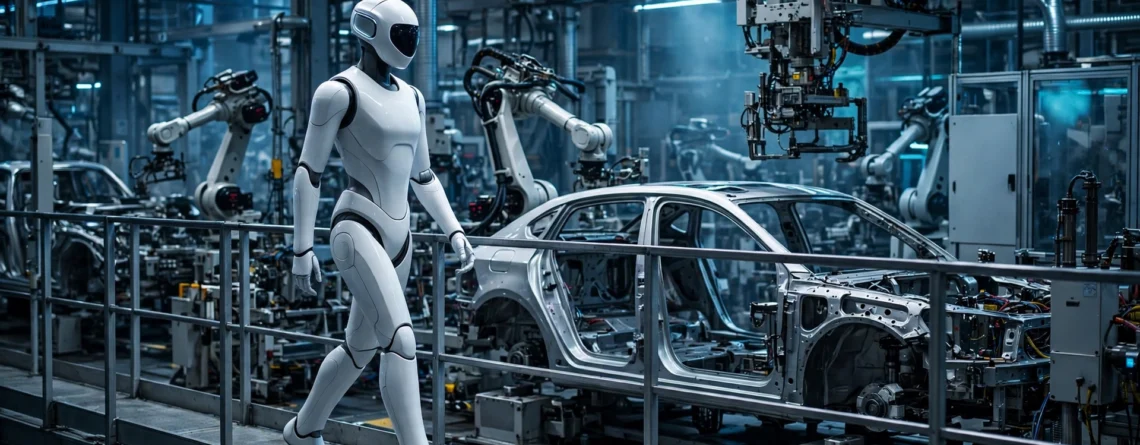
XPeng has also commissioned what it calls the world’s first automated production line for advanced humanoid robots, with over 80% of core processes automated and built to automotive-grade quality standards. A next-generation IRON unit recently walked off the line on its own — a symbolic shift from R&D prototype to line manufacturing.
Timeline
- End of 2026: mass production begins, with initial deployments at XPeng stores and campuses
- 2027: official launch, with deliveries in China and overseas markets
CEO He Xiaopeng has taken direct oversight of the robotics business, saying he intends to replicate the supply chain, manufacturing, and globalization capabilities XPeng built through its vehicle operations. The company has also set up an embodied intelligence data factory in Guangzhou to feed robot model training. Robotics is now one of the company’s three growth curves, alongside its core automotive business and international expansion — and XPeng expects gross margins per humanoid robot to be significantly higher than for new energy vehicles.
Why it matters
The humanoid race is entering its manufacturing phase. Funding announcements are easy; volume production at consistent quality and cost is the hard part — a challenge even Tesla’s Optimus program has publicly acknowledged. XPeng’s bet is that a decade of automotive manufacturing know-how gives it an edge most robotics startups don’t have. Whether that edge survives contact with real factory floors will be the story to watch through 2027.
Sources: Daily AI Brief, Robotics and Automation News, StockTitan

LEAVE A COMMENT