


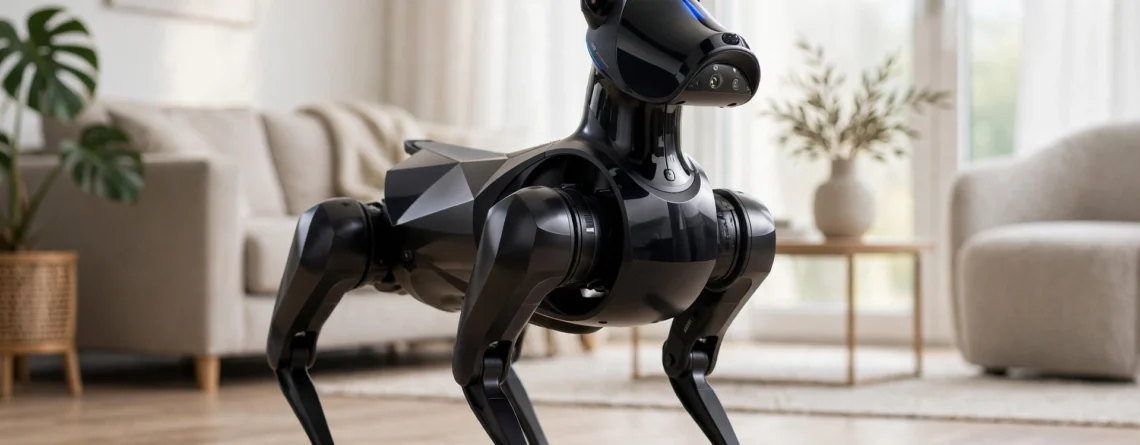
Xiaomi CyberDog 2: The Robot Dog That Wants to Live in Your House
The Unitree Go2 won the spec war. But Xiaomi looked at the robot dog race and asked a different question: what if the goal isn’t to build the fastest quadruped — but the one you’d actually want living in your home?
The CyberDog 2 is Xiaomi’s answer. It’s the world’s second most popular robodog, and it’s playing a completely different game.
From Creepy to Cute
Let’s be honest about the original CyberDog: it looked like a toaster with legs. Xiaomi heard the feedback. The CyberDog 2 was redesigned from the ground up to resemble an actual dog — specifically a Doberman, in both head shape and gait — standing 36.7 cm tall and weighing just 8.9 kg.
At half the weight of the Go2, this is a machine you can pick up with one hand. Your kids can play with it. It won’t dent your hardwood floors. That design choice tells you everything about who it’s for.
The Spec Sheet
| Specification | Xiaomi CyberDog 2 |
| Price | ~$1,785 (¥12,999) |
| Weight | 8.9 kg |
| Height | 36.7 cm |
| Degrees of freedom | 12 (CyberGear micro-actuators) |
| AI compute | NX chip, 21 TOPS + 2 co-processors |
| Sensors | 19 (depth, fisheye, ToF, LiDAR, ultrasonic, touch, 4 mics) |
| Top speed | 1.6 m/s |
| Battery | ~90 min |
| Memory | 8 GB RAM, 16 GB storage |
| Connectivity | Bluetooth 5.0, Wi-Fi |
| Open source | Code + structural drawings + graphical programming |
The CyberGear micro-actuators are Xiaomi’s own design — greater torque, faster response, more precise control than the first generation. And those 19 sensors covering vision, touch, and hearing make it one of the most perceptive consumer robots ever sold.
What It Can Actually Do
Backflips. Continuously. The signature trick — chained backflips with the kind of grace that made launch audiences gasp. Fall recovery is equally impressive: knock it over and it gets up like nothing happened.
Recognize you. Face recognition, human presence detection, gesture response. It tracks its owner, learns routines, and responds to voice commands through Xiaomi’s AI voice algorithm.
Change its colors. My favorite detail: an E-Ink Prism skin — essentially an external display — that dynamically changes color based on what it’s doing. Racing stripes during zoomies, if you want them.
Run the smart home. This is the killer feature nobody talks about enough. Deep integration with Xiaomi’s AIoT platform and Mi Home app means the CyberDog 2 isn’t just a robot — it’s a mobile smart-home hub with legs.
Teach itself. Through reinforcement learning and 30,000+ simulated dog training sessions, it doesn’t just execute commands — it adapts.
Where It’s Actually Useful
Home security patrol. It maps your home, follows patrol routes, and investigates unusual sounds or movement — a guard dog that never sleeps and sends video to your phone.
Companionship. Let’s not pretend this doesn’t matter. For elderly people living alone, kids learning responsibility, or anyone who wants a pet without the vet bills — the CyberDog 2 fills a real emotional niche.
Developer playground. Xiaomi made it as open-source as possible: coding, structural drawings, graphical programming, over 100 open interfaces. It’s arguably the most hackable consumer robot dog on the market.
Education. At this price with this openness, universities and STEM programs get a serious robotics platform that students actually want to touch.
Content creation. Let’s be real — a color-changing backflipping robot dog is a social media cheat code.
CyberDog 2 vs. Go2: The Honest Comparison
| CyberDog 2 | Unitree Go2 | |
| Price | ~$1,785 | From ~$1,600 |
| Weight | 8.9 kg | ~15 kg |
| Top speed | 1.6 m/s | 3.5 m/s |
| Battery | ~90 min | 1–2 h |
| Sensors | 19 (vision/touch/hearing) | 4D LiDAR + camera |
| Compute | 21 TOPS NX | 8-core CPU |
| Strength | Ecosystem + openness | Performance + autonomy |
| Best for | Home, companionship, hacking | Work, research, speed |
The Go2 is the athlete. The CyberDog 2 is the pet. Neither is “better” — they’re answering different questions.
The Honest Caveats
- Slower and weaker than the Go2. 1.6 m/s vs 3.5 m/s is not close. If you need performance, look elsewhere.
- Battery life is short. ~90 minutes. This is a companion, not a worker.
- Availability. Primarily sold in China — getting one elsewhere takes effort and import costs.
- Xiaomi’s robot track record. The original CyberDog and the CyberOne humanoid didn’t exactly take over the world. The ecosystem bet needs to pay off long-term.
- Privacy. 19 sensors including cameras and microphones, in your home, from a Chinese tech giant. Set your data sharing preferences deliberately.
The Bottom Line
Here’s what I respect about the CyberDog 2: Xiaomi didn’t try to out-Unitree Unitree. They looked at the robot dog and saw what it could become — not a lab instrument, but a household member.
The Go2 proved robot dogs could be affordable. The CyberDog 2 is trying to prove they can be lovable. Half the weight, twice the charm, open to anyone who wants to tinker.
The athlete vs. the pet. The lab vs. the living room. Honestly? I’m glad we don’t have to choose just one future.
Disclosure: Robot Zone participates in affiliate programs. If you purchase through links on this site, we may earn a commission at no extra cost to you.
Sources
- Unitree Go2 vs Xiaomi CyberDog — RobotiChina
- CyberDog 2: Xiaomi’s Next-Gen Open-Source Robot Dog — TechLog360
- Xiaomi CyberDog 2 Revealed, 19 Sensors — TechEBlog
- Xiaomi CyberDog 2: Bio-Inspired Robot — AndroidHeadlines
- Forget Boston Dynamics, This Robotic Dog Can Change Colour — T3
- Xiaomi CyberDog 2 Can Do Backflips and Recognize Faces — ShiftDelete









LEAVE A COMMENT