



Agentic AI: How Artificial Intelligence Combines Analysis and Generativity to Make Robots More Autonomous
For decades, robots were excellent at exactly one thing: repeating a programmed motion, forever, in a perfectly controlled environment. Change one variable — a box in the wrong place, a new product on the line — and the whole system broke down.
That era is ending. A new paradigm called agentic AI is turning robots from scripted machines into goal-driven agents that perceive, reason, plan, and act on their own. In 2026, this shift is moving from research labs to warehouses, factories, and even homes. Here is how it works — and what it means for anyone buying or deploying robots today.
From Scripts to Agents: What Changed
Traditional industrial robots run on explicit programming: engineers define every joint angle, every waypoint, every exception handler. The robot analyzes sensor input only to stay on its script.
Agentic AI flips this model. Instead of a script, the robot receives a goal — “clear this bin,” “restock aisle 7,” “assemble this part” — and figures out the steps itself. Two capabilities make this possible, and their combination is the real breakthrough:
- Analysis: vision-language-action (VLA) models let robots understand what they see, reason about physics and space, and predict the outcome of their actions before moving.
- Generativity: the same class of models that writes text and generates images can now generate action plans — novel sequences of movements for situations the robot has never encountered.
A robot that can both understand its environment and invent its own plan is no longer a machine executing code. It is an agent pursuing an objective.
The Building Blocks Arrived in 2026
The foundation models powering this shift matured fast this year:
- NVIDIA Isaac GR00T, NVIDIA’s foundation model platform for humanoid robots, expanded significantly in 2026, giving developers a shared “brain” for general-purpose humanoids instead of training every behavior from scratch.
- Google Gemini Robotics ER-1.6 (April 2026) brought enhanced spatial and physical reasoning to real robots through a deployment partnership with Agile Robotics.
- Open VLA models like NVIDIA’s Alpamayo pair driving and manipulation trajectories with chain-of-causation reasoning, making robotic decisions explainable — a requirement for production deployment.
Meanwhile, investment is pouring into “Physical AI”: Jeff Bezos is reportedly raising $10B at a $38B valuation for Project Prometheus, a venture dedicated to embedding AI into physical systems and robotics.
Where Agentic Robots Already Work
Warehouses: the autonomous floor manager
Warehouses are the proving ground. DHL Supply Chain partnered with HappyRobot to deploy agentic AI that acts as an autonomous floor manager: the agents ingest real-time IoT sensor data, coordinate robotic pickers and conveyors, dynamically re-slot inventory based on demand, and reroute work when a machine fails — without stopping the operation. Appointment scheduling and driver follow-ups that took days now take hours.
Symbotic’s large-scale 2026 deployments with major U.S. retail networks push the same idea further: fully automated case handling and pallet building orchestrated end-to-end by AI.
Factories: from copilots to agents
Siemens launched Industrial AI Agents as a deliberate shift “from AI copilots to semi-autonomous agents that execute complete industrial processes end-to-end”. At IMTS 2026, Vention debuted MachineAgent, which generates automation cell layouts from plain-language prompts, writes the industrial programs, and analyzes fleet data to diagnose underperforming machines on its own.
Humanoids: leaving the lab
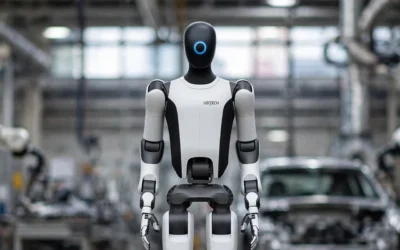
The most visible agents have two legs. Tesla’s Optimus Gen 3 entered mass production in summer 2026, Boston Dynamics’ Atlas is operational in Hyundai manufacturing — reportedly the first humanoid deployed for real physical tasks, and startups like 1X began limited in-home trials, with robots handling soft, unpredictable objects like laundry using foundation models for physics rather than pre-set programming.
Researchers at MIT even demonstrated “speech-to-reality”: describe an object in natural language, and the system designs the blueprints and directs robotic arms to assemble it — no CAD, no code.
What This Means for Robot Buyers
If you are evaluating robots for your business in 2026, the buying criteria are changing:
- Ask about the AI stack, not just the hardware. Two robots with similar arms can differ enormously in autonomy depending on whether they run scripted routines or a VLA foundation model.
- Pilot for adaptability, not just speed. The ROI of agentic robots shows up when conditions change — new SKUs, layout changes, seasonal peaks — without reprogramming.
- Plan for supervision, not operation. Agentic systems still need humans on the loop: setting goals, handling edge cases, and auditing decisions. The job shifts from joystick operator to fleet supervisor.
- Start where the data is. Warehouses and structured manufacturing offer the sensor-rich environments where agentic AI performs best today; fully unstructured settings remain frontier territory.
The Bottom Line
Agentic AI is the moment robotics stops being about better motors and starts being about better minds. By combining analytical perception with generative planning, robots are becoming agents that pursue goals instead of executing scripts — and 2026 is the year this moved from demo videos to paying deployments.
Robot Zone will keep tracking which platforms deliver real autonomy and which are still marketing. The race for the robot brain is on.
Disclosure: Robot Zone participates in affiliate programs. If you purchase through links on this site, we may earn a commission at no extra cost to you.
Sources
- Awesome AI Agents 2027 — Physical AI & Embodied Agents
- The 2026 Shift: From Generative Tools to Autonomous Agents — The Quantiq
- Agentic AI & AGI Breakthroughs: Jan–Feb 2026
- Agentic AI Use Cases: 7 Real Examples Transforming Enterprise in 2026 — DQIndia
- Top 50 Agentic AI Implementations — 8allocate
- Vention at IMTS 2026 — Industrial Machinery Digest









LEAVE A COMMENT