


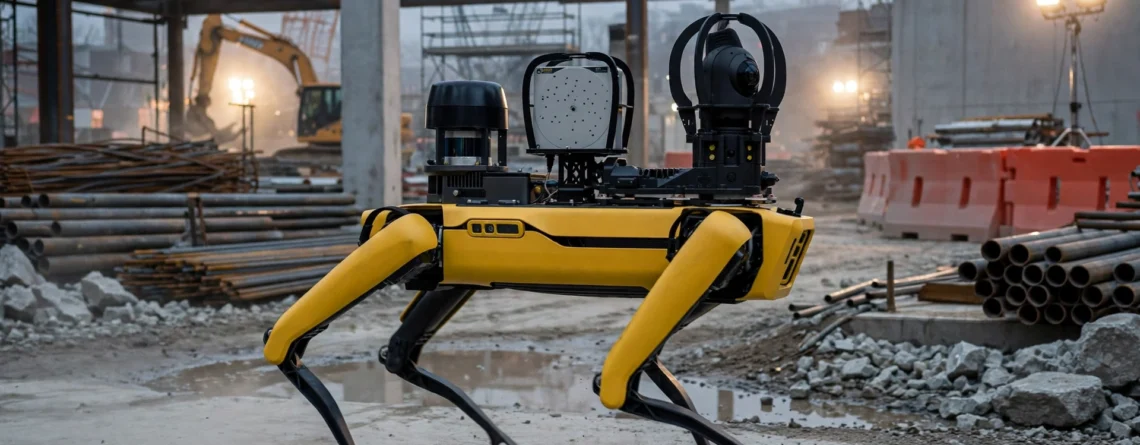
Boston Dynamics Spot: The $74,500 Robot Dog That Started It All
Before the backflips, before the $1,600 price tags, before robot dogs were a product category at all — there was Spot.
You’ve seen it. Dancing to “Do You Love Me.” Trotting through a construction site. Getting kicked by an engineer and refusing to fall over. Boston Dynamics spent the better part of a decade turning Spot from a DARPA-funded experiment into the most recognizable robot on Earth — and then, in 2020, did something nobody expected: they put a price tag on it.
$74,500. For a robot dog. Let me explain why serious companies pay it anyway.
The Spec Sheet
| Specification | Boston Dynamics Spot |
|---|---|
| Price | ~$74,500 (base Explorer package) |
| Weight | 32.5–33.8 kg (with battery) |
| Dimensions | 1,100 × 500 mm, 840 mm standing |
| Degrees of freedom | 12 |
| Max speed | 1.6 m/s |
| Max payload | 14 kg (two mounting rails) |
| Battery | 564–605 Wh, ~90 min runtime, 180 min standby |
| Recharge | ~60–120 min (swappable batteries) |
| Ingress protection | IP54 (splash-proof) |
| Operating temperature | −20°C to 45/55°C |
| Terrain | Slopes ±30°, steps up to 300 mm |
| Perception | 360° stereo cameras, 4 m range |
| Connectivity | Wi-Fi, Ethernet, optional cellular |
| Payload power | 2 ports, up to 150 W each |
These figures come from Boston Dynamics’ public specs — though fair warning: the product page and SDK docs don’t agree on every number, so enterprise buyers should demand the exact spec sheet for their quoted revision.
What It Can Actually Do
Walk anywhere. Stairs, gravel, mud, grass, snow, rubble — Spot traverses rough terrain and self-rights when it falls. The 360° stereo vision maps obstacles up to 4 meters out, in lighting as low as 2 lux.
Carry serious equipment. 14 kg across two payload rails, with 150 W of power per port. That’s a LiDAR, a thermal camera, a gas detector, and a radio — all at once. This is what separates Spot from consumer quadrupeds: it’s a mobile sensor platform, not a pet.
Work alone. With the Orbit fleet management software, Spot runs autonomous inspection missions on pre-programmed routes, docks itself to recharge, and uploads data without human supervision.
Take a beating. IP54, −20°C operation, dynamic balancing against shoves and slips. This machine was designed for places that would destroy a consumer robot in a week.
Where It’s Actually Useful
Industrial inspection. Oil & gas, chemical plants, power generation, manufacturing. Spot does the rounds — reading gauges, scanning for thermal anomalies, detecting gas leaks — in areas too dangerous, boring, or remote for humans.
Construction. Daily site documentation, progress tracking, safety monitoring. Same angles, same positions, every single day — repeatability no human crew can match.
Public safety. Over 60 US and Canadian bomb squads and SWAT teams use Spot for bomb calls, hazmat, and barricaded suspects — jobs where sending an officer is dangerous. (Deployments remain politically debated, notably New York’s proposed ASIMOV Act.)
Search and rescue. Rubble piles, collapsed structures, disaster zones — Spot goes where rescue workers can’t yet.
Research. Universities and labs use Spot as the gold-standard legged platform, with a mature SDK and a decade of published locomotion research behind it.
Spot vs. The World
The question everyone asks: is Spot better than a Unitree Go2? They answer different questions. A Go2 costs $1,600–$2,800 and is the rational choice for hobbyists, education, and budget research. Spot costs one to two orders of magnitude more — and buys enterprise autonomy software, a payload ecosystem, support contracts, and procurement acceptability for utilities, factories, and public agencies.
Against the Unitree B2 (~half the price, 40+ kg payload, IP67, 5-hour battery), Spot looks expensive for raw capability — but Boston Dynamics sells reliability, software maturity, and a support organization, not just hardware.
The Honest Caveats
- The price is the whole story. $74,500 base — and real deployments cost far more with payloads, spare batteries, docks, and integration.
- You probably can’t buy one. Boston Dynamics doesn’t sell to individuals for non-commercial use. No online ordering — the web shop sells plush Spots, not robots.
- 90-minute battery. Swappable, but continuous operation needs docks or spares.
- IP54, not IP67. Splash-proof, not washdown-proof. Harsh water exposure is out.
- Not for smooth floors. If your site is mostly flat corridors, a wheeled robot is cheaper and better.
- No explosive-environment certification. Unlike some rivals, Spot isn’t rated for ATEX Zone 1 areas.
The Bottom Line
Here’s the thing about Spot: it was never really a product. It was a proof — that legged robots could work in the real world, that they’d be useful, that an industry could exist.
Every $1,600 robot dog on the market today exists because Spot spent a decade taking the hits: the R&D costs, the skepticism, the “why would anyone buy this” headlines. Boston Dynamics built the category. Unitree and Xiaomi democratized it.
The Go2 is the athlete. The CyberDog 2 is the pet. Spot is the pioneer — expensive, imperfect, and still the machine every serious industrial buyer compares everything else against.
Respect the OG.
Disclosure: Robot Zone participates in affiliate programs. If you purchase through links on this site, we may earn a commission at no extra cost to you.
Sources
- ANYmal vs Spot for Industrial Maintenance — Oxmaint: https://oxmaint.ai/blog/post/best-anymal-vs-spot-industrial-maintenance-2026
- Boston Dynamics Spot: Capabilities, Specs, Benchmarks — RoboticsNewsAI: https://roboticsnewsai.com/boston-dynamics-spot-robot-buyers-review/
- Boston Dynamics Robot Dog: Price, Specs & Who Buys It — RoboZaps: http://blog.robozaps.com/b/boston-dynamics-robot-dog
- Unitree B2 vs Boston Dynamics Spot — DronesPlusRobotics: https://www.dronesplusrobotics.com/post/unitree-b2-vs-boston-dynamics-spot-robot-dog-a-comprehensive-comparison
- Boston Dynamics Spot Review 2026 — AntonRobots: https://antonrobots.com/boston-dynamics-spot-review/
- Spot SDK Specifications — Boston Dynamics GitHub: https://github.com/boston-dynamics/spot-sdk/blob/HEAD/boston-dynamics-spot-sdk-9d3237d/docs/concepts/about_spot.md
- Spot by Boston Dynamics: Specs & Features — OriginOfBots: https://www.originofbots.com/robot-dog/spot-by-boston-dynamics-robot-dog-specifications







LEAVE A COMMENT