


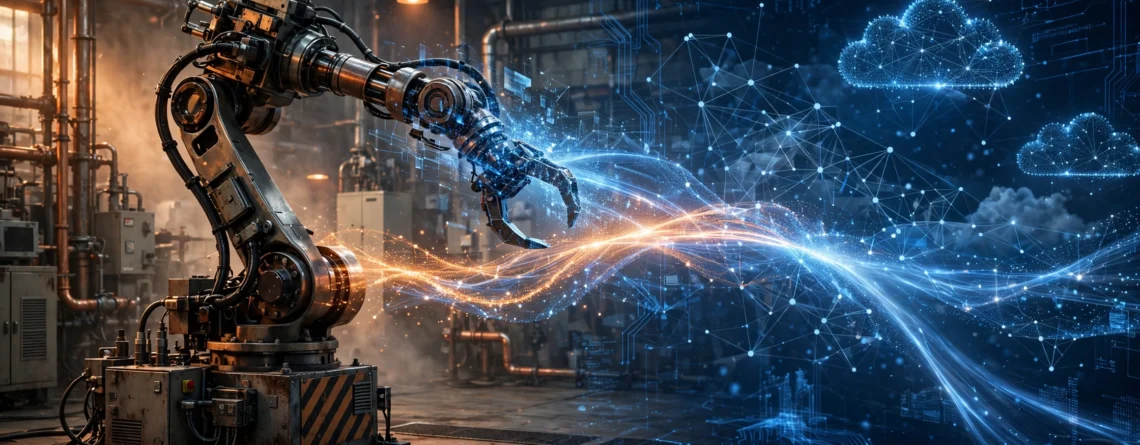
The Convergence Between IT and Operational Technology to Increase Machine Versatility
The International Federation of Robotics (IFR) named it one of the top five global robotics trends for 2026: “Robots: IT Meets OT.” Demand for versatile robots is accelerating, the IFR reports, and this directly reflects a market push toward the convergence of Information Technology (IT) and Operational Technology (OT).
It sounds like enterprise jargon. In practice, it is the reason a single robot on your factory floor will soon be able to do five jobs instead of one. Here is what the convergence means, why it matters, and where it is already happening.
IT vs. OT: A 30-Second Primer
- Information Technology (IT) is the world of data: servers, cloud platforms, business software, analytics dashboards, AI models. It thinks in databases and networks.
- Operational Technology (OT) is the world of physical control: PLCs, robot controllers, sensors, actuators, SCADA systems. It thinks in milliseconds, torque, and emergency stops.
For decades these two worlds barely spoke. The office network ran the business; the shop floor ran the machines, often on isolated, decades-old control systems. A robot knew its programmed routine and nothing else — no access to order data, no awareness of what the machine next door was doing.
Convergence tears down that wall. When IT’s data-processing power merges with OT’s physical control capabilities, robots gain real-time data exchange, automation, and advanced analytics — the three ingredients of versatility.
Why Convergence Makes Machines More Versatile
A traditional robot is versatile the way a vinyl record is versatile: it plays its track perfectly, but changing the track means reprogramming. IT/OT convergence changes the equation in four ways:
1. Real-time data exchange. When the robot controller talks directly to the ERP and MES systems, the machine knows what is coming down the line before it arrives. A welding robot can pull the CAD file for the next variant automatically instead of waiting for an engineer to load a new program.
2. AI-driven adaptability. The IFR notes that analytical AI helps robots process large datasets and anticipate failures before they occur, while generative AI lets them learn new tasks autonomously. None of this works without IT-grade compute and data pipelines feeding the OT layer.
3. Digital twins and simulation. ABB’s partnership with NVIDIA exemplifies the shift: instead of programming robots manually, manufacturers generate unlimited training scenarios in simulation, collapsing deployment timelines from weeks to days. The twin lives in IT; the robot lives in OT; convergence is the bridge.
4. Edge computing. In 2026, robots no longer wait for a distant cloud server to make safety-critical decisions — the “brain” is onboard, processing sensor data in milliseconds. Edge nodes are where IT infrastructure physically meets OT timing requirements.
Where It Is Already Happening
IMTS 2026 was a showcase for converged systems. FANUC robots appeared everywhere — not just in FANUC’s own booth but as building blocks inside integrators’ cells. Athena 3D Manufacturing used a FANUC CRX collaborative robot to automate print-bed changes across multiple 3D printers, nearly doubling part production and increasing machine utilization by 40% while enabling lights-out operation. The robot did not do the printing; it orchestrated the fleet — a versatility play made possible by IT-level coordination of OT-level machines.
The AMT Emerging Technology Center demonstrated a convergent manufacturing platform for drone production that connected machine tools, robots, cobots, pallet changers, and additive manufacturing into one system — then proved flexibility by producing three different drone body sizes on the same setup.
Siemens, meanwhile, moved from AI copilots to Industrial AI Agents that execute complete industrial processes end-to-end — detecting low component stock, triggering procurement, adjusting schedules, and initiating maintenance before downtime occurs.
The Challenges Nobody Should Ignore
Convergence expands the attack surface. The IFR flags increasing cybersecurity threats targeting robot controllers and cloud platforms, and OT security is racing to catch up with behavioral anomaly detection, microsegmentation, and zero-trust architectures applied to industrial networks.
Safety and liability frameworks are lagging too: deep-learning models acting as “black boxes” create legal ambiguity about responsibility when autonomous systems cause harm, and governance has not kept pace with deployment.
Any buyer evaluating converged robotics should ask vendors two questions: how is the OT network segmented from IT, and who is liable when the AI makes a bad call?
What It Means for Robot Buyers
- Evaluate the software platform, not just the arm. A robot’s versatility in 2026 comes from its data integrations — ERP/MES connectivity, digital twin support, edge AI — more than from its payload specs.
- Demand open interfaces. Converged cells mix vendors (a FANUC arm, a Siemens PLC, an NVIDIA-powered vision system). Proprietary lock-in kills versatility.
- Budget for cybersecurity. An IT-connected robot is an IT security problem. Segment networks and patch controllers like you patch servers.
- Start with a high-changeover process. Versatility pays off fastest where product variants change often — the ROI case writes itself.
The Bottom Line
IT/OT convergence is not a buzzword; it is the architectural shift that turns single-task machines into flexible manufacturing platforms. The IFR put it on its 2026 trends list for a reason: the factories winning the next decade will be the ones where data flows as freely as parts.
Robot Zone will keep tracking which platforms deliver genuine versatility — and which ones just added an Ethernet port and called it convergence.
Disclosure: Robot Zone participates in affiliate programs. If you purchase through links on this site, we may earn a commission at no extra cost to you.
Sources
- Top 5 Global Robotics Trends 2026 — International Federation of Robotics Reports
- The Rise of AI-Powered Robotics: How 2026 Is Reshaping Manufacturing and Automation — TechnologAI
- Robots Take Center Stage at IMTS 2026 — Fabbaloo
- IMTS 2026 Accelerates Technology Adoption — ManufacturingTomorrow
- Robotics & Automation Technologies Transforming Industries — Plant Automation Technology
- The Convergence of Generative AI and Advanced Robotics in 2026 — que.com




LEAVE A COMMENT