


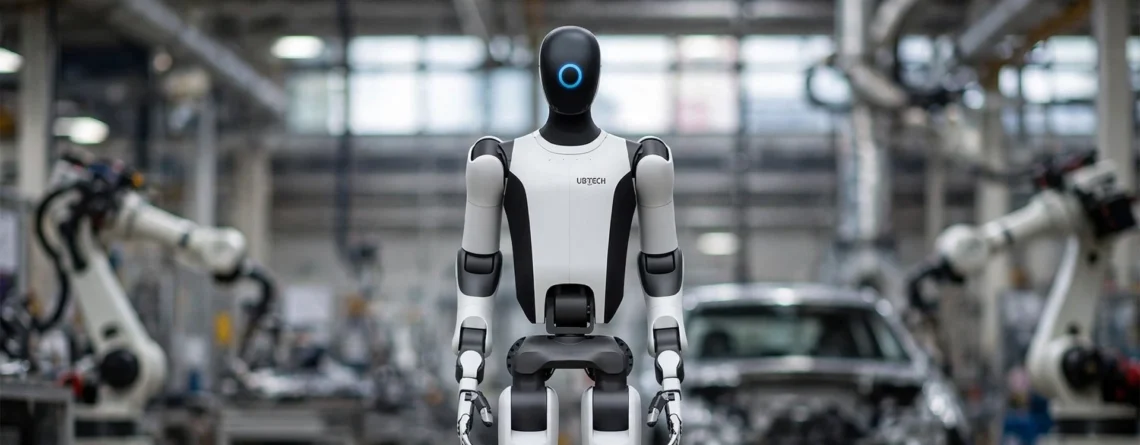
UBTech Walker S2: The Industrial Humanoid Already Working in Real Factories
While most humanoid robots are still auditioning for their first real job, the UBTech Walker S2 is already clocking in. Hundreds of units work on production lines at BYD, Foxconn, Geely, and FAW-Volkswagen — making the Walker S2 the most industrially deployed humanoid robot in the world in 2026.
Here are its full specifications, what it does on factory floors, and the advantages behind UBTech’s industrial lead.
Why the Walker S2 Matters
UBTech Robotics of Shenzhen completed the world’s first mass delivery of industrial humanoid robots, with 2025 contracts exceeding 800 million yuan (about $113 million) and the first hundreds of Walker S2 units operating on real production lines — not in laboratories. As of early 2026, the S2 is deployed or under active evaluation across automotive (BYD, Geely, FAW-Volkswagen, Audi FAW, BAIC, Dongfeng Liuzhou Motor), electronics (Foxconn, Texas Instruments), logistics (SF Express), aerospace (Airbus), and data centers.
In September 2026, UBTech opened a 10,000-unit super smart factory in Liuzhou — designed with Siemens digital-twin technology — the first plant sized for five-figure annual humanoid output.
Full Specifications
| Specification | Walker S2 |
|---|---|
| Height | 176 cm (5’9″) |
| Weight | 70 kg (154 lbs) |
| Degrees of freedom | 52 (legs 12, arms 14, waist 2, head 2, hands 22) |
| Walking speed | 2.0 m/s |
| Payload | 15 kg dual-arm combined (7 kg single hand) |
| Waist rotation | ±162° |
| Workspace | 0–1.8 m |
| Vision | Pure RGB binocular stereo vision (sub-6mm depth error) |
| AI platform | BrainNet 2.0 + Co-Agent dual-loop architecture |
| Operating system | ROSA 2.0 (Ubuntu-based) |
| Battery | ~2h active / 4h standby; autonomous 3-minute hot-swap |
| Safety | ISO 10218-1, ISO/TS 15066, force-feedback joints, torso e-stop |
| Connectivity | Wi-Fi |
| Price | ~213,109 CAD (listed) |
| Availability | In production, mass delivery underway |
The Walker S2 stands 176 cm tall, weighs 70 kg, and packs 52 degrees of freedom — the highest figure among serial industrial humanoids. Its 15 kg payload and 2 m/s walking speed put it in a different class from research-oriented humanoids.
What It Can Actually Do
Heavy industrial work. With 15 kg of dual-arm payload and force-feedback joints, the S2 handles material transport, component loading, and high-speed sorting — tasks that lighter humanoids simply cannot do.
Precision assembly. The pure RGB binocular vision system delivers depth error under ±6mm within 1.5 meters — critical for inserting small components or quality inspection. On automotive lines, S2 units perform door-lock testing, oil-cap assembly, and logo application with vision-guided precision.
Work 24/7. The S2 is the world’s first industrial humanoid with autonomous battery swapping — it changes its own battery in 3 minutes, eliminating charging downtime and enabling round-the-clock operation.
Collaborate. Powered by BrainNet 2.0 and Co-Agent AI, multiple S2 units share task data, coordinate movements without collision, and run synchronized workflows on the same line.
Work safely beside humans. Force-feedback joints detect contact and modulate force in real time; the software complies with ISO 10218-1 and ISO/TS 15066 collaborative-robot standards, and each unit has a torso-mounted emergency stop.
The Advantages
- The deployment record nobody else has. Hundreds of units at BYD, Foxconn, Geely, FAW-Volkswagen, SF Express — plus Airbus evaluating units for aerospace assembly since January 2026. This is the largest real-world industrial deployment of any humanoid.
- Measured productivity gains. Evaluations at BYD showed a 120% efficiency increase in component sorting tasks.
- True 24/7 operation. The 3-minute autonomous battery swap is a genuine industry first — no other serial humanoid can work continuous shifts without human intervention.
- Human-scale design. At 176 cm with a 0–1.8 m workspace and ±162° waist rotation, the S2 fits workstations designed for people — no factory redesign required.
- Manufacturing scale. The Liuzhou super factory targets 10,000 units per year, with UBTech aiming for 1,000 deliveries by end of 2025 and 10,000 in 2026.
- Industrial-grade support. 12-month warranty, lifetime free software upgrades, cost-price spare parts for 15 years, and free engineer training — the service package factories expect.
The Fine Print
Honesty first: UBTech disclosed in January 2026 that the Walker S2 operates at roughly 50% of human worker efficiency, with an internal target of 80% by 2027. Current deployments focus on repetitive, mobility-heavy tasks — material transport, loading, inspection — where the humanoid form beats fixed automation but experienced human workers still set the ceiling. And at ~213,000 CAD per unit, this is capital equipment, not a gadget.
Who Should Buy One?
- Automotive and electronics manufacturers — the proven use case, with reference deployments at industry giants.
- Logistics operators — 24/7 material handling with the battery-swap system.
- Aerospace — Airbus is already evaluating; precision plus human-scale reach fits assembly support.
- Industrial integrators — multi-robot collaboration and a full service package.
The Bottom Line
The UBTech Walker S2 is the answer to the question everyone asks about humanoids: “But do they actually work?” Hundreds of them do — every day, on real production lines, for the world’s biggest manufacturers. It is not the cheapest humanoid, nor the most agile. It is the most employed one.
Robot Zone’s take: Agibot wins on volume, Unitree on price — but if you need a humanoid earning its keep in a factory today, the Walker S2 is the only name with the deployment record to prove it.
Disclosure: Robot Zone participates in affiliate programs. If you purchase through links on this site, we may earn a commission at no extra cost to you.
Sources
- UBTECH Walker S2 Guide: Specs, Price, and Industrial Use — AsiaSatellite
- UBTECH Humanoid Robot Analysis — Skilldential
- Walker S2 Product Page — Made-in-China.com
- UBTECH Walker S2 Full Guide 2026 — Canada Satellite
- Walker S2 Specs — RoboAtlas
- Airbus Explores Humanoid Robotics With China’s UBTech — eWeek
- UBTECH Deploys Hundreds of Walker S2 at BYD and Foxconn — Blockchain.News
- Hundreds of Walker S2 Poised for BYD, Foxconn — El Sky News
- China Humanoid Factory Hits 10-Minute Production Pace — TechTimes
- China Deploys Humanoid Robots — eWeek
- UBTECH Opens 10,000-Unit Humanoid Factory in Liuzhou — The Robotics Media





LEAVE A COMMENT